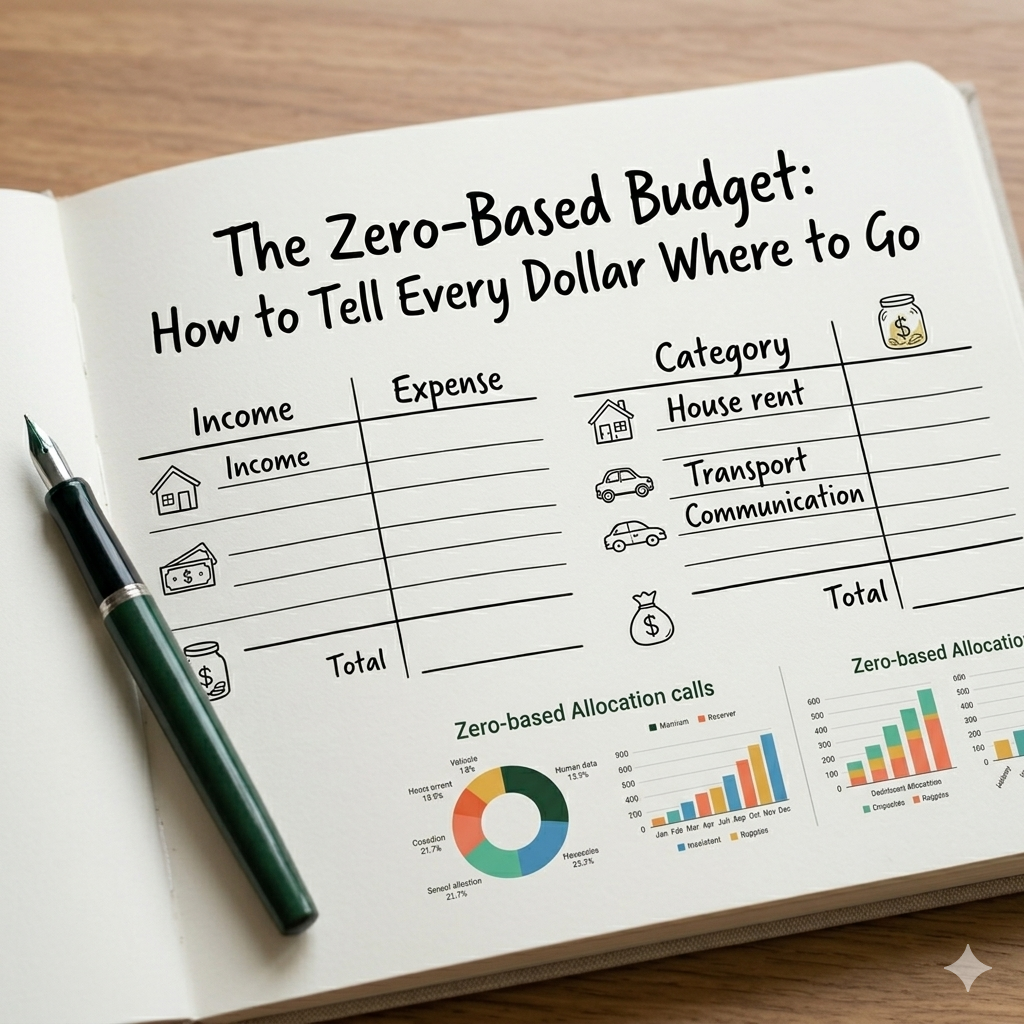
Most budgets fail for a simple reason: they’re too vague. You set a rough spending limit for “food” and “entertainment”, overspend by $200, feel guilty for a week, and abandon the whole thing by February. Sound familiar?
Zero-based budgeting fixes this by forcing you to account for every single dollar you earn — before the month begins. It’s the most powerful personal budgeting method there is, and after reading this guide, you’ll know exactly how to set one up in an evening.
🎯 Key Takeaway: Zero-based budgeting means your income minus all your planned spending and saving equals exactly zero. Every dollar has a job before the month starts.
What Is Zero-Based Budgeting?
The term was coined by financial educator Dave Ramsey, though the concept is simpler than it sounds. Zero-based budgeting (ZBB) means you start each month with your income and assign every dollar a specific purpose until you reach zero.
That doesn’t mean you spend everything. It means you plan everything — including savings, investments, and debt payments. If you earn $4,000 this month, every dollar of that $4,000 gets assigned to a category before the month begins, so that $4,000 income minus $4,000 in planned spending and saving equals $0.
The difference between ZBB and a traditional budget is intentionality. Traditional budgets set spending limits. Zero-based budgets require you to actively decide in advance what every dollar will do.
Why Zero-Based Budgeting Works When Others Don’t
Three things make ZBB more effective than conventional budgeting:
- It eliminates “lost” money. In a traditional budget, money that doesn’t fall neatly into a category just… disappears. ZBB catches every dollar, including the $40 subscriptions you forgot about and the $80/month you were spending on coffee without realizing it.
- It forces conscious spending decisions. When you have to assign every dollar a purpose, impulse spending becomes harder. You can’t blow $150 on Amazon without consciously moving money from another category first.
- It adapts month to month. Your expenses in January (holiday returns, lower utilities) look completely different from August (back-to-school, higher AC bills). ZBB lets you rebuild the budget fresh each month to match your actual life.
- It works on any income. Whether you make $30,000 or $300,000 a year, whether your income is fixed or variable, the zero-based framework applies equally. It’s especially powerful for freelancers and people with irregular income.
💡 Pro TipDave Ramsey’s research found that people who use a written budget — any budget — spend up to 20% less per month than those who don’t. Zero-based budgeting amplifies this effect because it’s the most specific form of written budgeting.